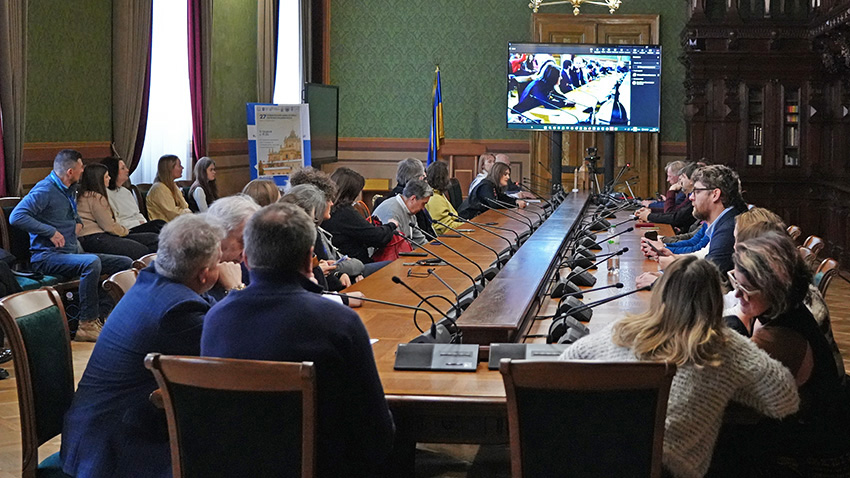
On 5 December, Lviv Polytechnic National University hosted an international event dedicated to the 27th anniversary of the inscription of Lviv’s historic centre on the UNESCO World Heritage List. The event became not only an opportunity for professional discussion of challenges and achievements in the field of cultural heritage protection, but also a clear demonstration of the university’s role as a scholarly and public institution responsible for preserving the city’s historical memory at both national and international levels.
The event opened in the university’s main building – an architectural monument that is itself an integral part of Lviv’s cultural landscape. In her opening remarks, the Rector of Lviv Polytechnic National University, Natalia Shakhovska, emphasised that for the university, the preservation of UNESCO heritage goes far beyond formal participation in cultural events. It involves systematic academic, educational, and project-based work aimed at training professionals capable of engaging with historical environments in a responsible and professional manner, particularly under conditions of wartime threats.
One of the key highlights of the programme was the presentation of a scale model planned for installation at the site of the lost Church of the Exaltation of the Holy Cross on Halytska Square. Implemented with the participation of Lviv Polytechnic scholars, the initiative demonstrates a contemporary approach to working with lost heritage sites – through scholarly reconstruction, public visualisation, and the engagement of the urban community in rethinking historical space.
A separate segment of the event was devoted to the presentation of a proposed component of the UNESCO World Heritage property – the main building of Lviv Polytechnic National University. Rector Natalia Shakhovska and Professor Mykola Bevz presented scholarly arguments highlighting the architectural, historical, and symbolic value of the building as an element of Lviv’s integrated cultural ensemble. In Professor Bevz’s presentation, particular attention was paid to restoration approaches and the importance of academic expertise in heritage protection processes.
The discussion continued with the presentation of the publication Restoration of the Assembly Hall of the Main Building of Lviv Polytechnic National University, which summarises many years of professional work on the restoration of one of the university’s most significant interiors. The publication serves as an example of how scholarly documentation and restoration practice can interact in the interest of preserving the authenticity of historic sites.
The event proceeded with the presentation of the results of the AURORA project Preserving Artistic Heritage in Times of War. The project demonstrated that Lviv Polytechnic actively responds to contemporary challenges by offering scientifically grounded solutions for the protection of cultural assets under conditions of military threat. Within the initiative, achievements aimed at documenting, analysing, and safeguarding artistic objects at risk of destruction or loss were presented. The project also underscored the importance of combining academic expertise, interinstitutional cooperation, and international experience in developing effective mechanisms for cultural heritage protection in times of crisis.
In his welcoming address, Lviv Mayor Andriy Sadovyi emphasised the importance of partnership between the city and the university in the field of UNESCO heritage protection, noting that the academic expertise of Lviv Polytechnic forms the foundation for strategic decision-making regarding the preservation of Lviv’s historic environment.
The final part of the programme included guided tours of the university’s main building and St. George’s Archcathedral – another component of the UNESCO World Heritage property – as well as a performance of Wolfgang Amadeus Mozart’s Requiem, which added a profound symbolic dimension to the event.
The event once again confirmed that Lviv Polytechnic not only preserves heritage, but also fosters a modern culture of responsibility for it – through scholarship, education, and public dialogue between the university, the city, and the global community.


