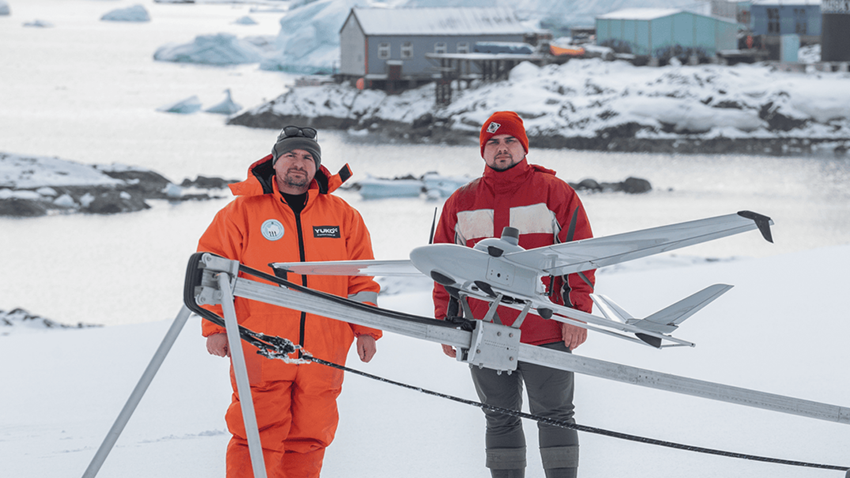
«When a storm rages in Antarctica, it sounds very loud. The building of the Akademik Vernadsky station is built of wood and stands without a classic foundation, so the wind whistles loudly behind the walls and under the floor, as if trying to blow everyone away to the Land of Oz. When the bad weather stops, absolute silence still does not come – you can hear the hum of penguins, which resembles the sounds of a Ukrainian village or a Tamagotchi toy, desperately reminding you of its existence. When you move far from the bird colony or go to neighboring islands, you can only hear the splash of ocean waves and the noise of the wind over rough snows…», says Ivan Brusak, PhD, Assistant at the Department of Higher Geodesy and Astronomy, the Institute of Geodesy, Lviv Polytechnic National University, scientist.

In 2021, Ukraine acquired a scientific research icebreaker, which has since become the flagship of the national scientific fleet. Formerly owned by the United Kingdom, the vessel was known as the RRS James Clark Ross, whose name can still be faintly seen beneath a layer of new paint. Today, the ship belongs to the National Antarctic Research Center and is called Noosphere. The term «noosphere» meaning «sphere of mind» was introduced by Academician Volodymyr Vernadskyi, after whom the Ukrainian Antarctic station is named, making the choice of name deeply symbolic.
Our scientists have the opportunity to go to the station on a comfortable ship with the Ukrainian coat of arms and a team, rather than hitchhiking.
When the opportunity arose, Pavlo Panasiuk, a captain from the Odesa region, invited us to the bridge and explained how the crew tracks icebergs – dense as concrete – and noted their significant decrease in the region in recent years. While the icebreaker is designed to withstand such impacts, no one takes unnecessary risks: the crew protects the ship like a pearl.
Life aboard the Noosphere felt like staying in a high-class hotel, with double cabins, delicious meals, and great company. During the first days, we were given a full tour of the ship and briefed on evacuation procedures. We were divided into teams according to the number of lifeboats and shown how to put on special thermal suits designed to prolong survival in icy waters.

Фото: Юрій Шепета
– Do you remember the moment when you first saw our polar station Akademik Vernadsky and Antarctica? What do you remember most?
We arrived at the station on an unusually sunny day. «Akademik Vernadsky» is located on Galindez Island, which is part of the Argentine Islands archipelago. Everything around shone and shimmered in the rays, and it was hard to believe that there could be a strong storm here. However, a few days later, bad weather began and we realized that Antarctica can be very different. It’s like our Carpathians – when it’s warm and sunny, you can’t imagine that you can die in the mountains. At some point, the weather shows how much it controls everything.
There is no pier near the station, so the ship Noosphere stops at a certain distance in one of the straits and the polar explorers get to Akademik Vernadsky in inflatable rubber boats, which scientists who have been there for a long time call zodiacs. Cargo is transported in the same way. When I first got into the boat and it sped towards the shore, all I could think about was how ridiculous it would be to fall into the water right at the destination.

Participating in the expedition is another powerful motivation for pursuing science in Ukraine. The results of our research showcase us as a nation that continues to move forward relentlessly, even in the midst of war. If we stop now, it will take years to make up for lost time.
Working at the station and exploring Antarctica feels like competing in the Olympic Games. I may not follow every sport, like high jumping, but I always take pride in our victories. Seeing the blue-and-yellow flag and hearing our anthem fills me with pride. A healthy patriotism thrives at the Akademik Vernadsky station. Scientists there consistently achieve high research standards on the global stage.
Yes, scientific research requires significant funding, but every investment goes into real work that advances science in Ukraine. The scientists truly work tirelessly, like Olympic athletes, bringing honor to our country through their achievements.

https://lpnu.ua/news/ivan-brusak-chudova-atmosfera-na-stantsii-ne-vidchuvaietsia-odrazu-prote-ne-zabuvaietsia-vzhe

Фото: Юрій Шепета

